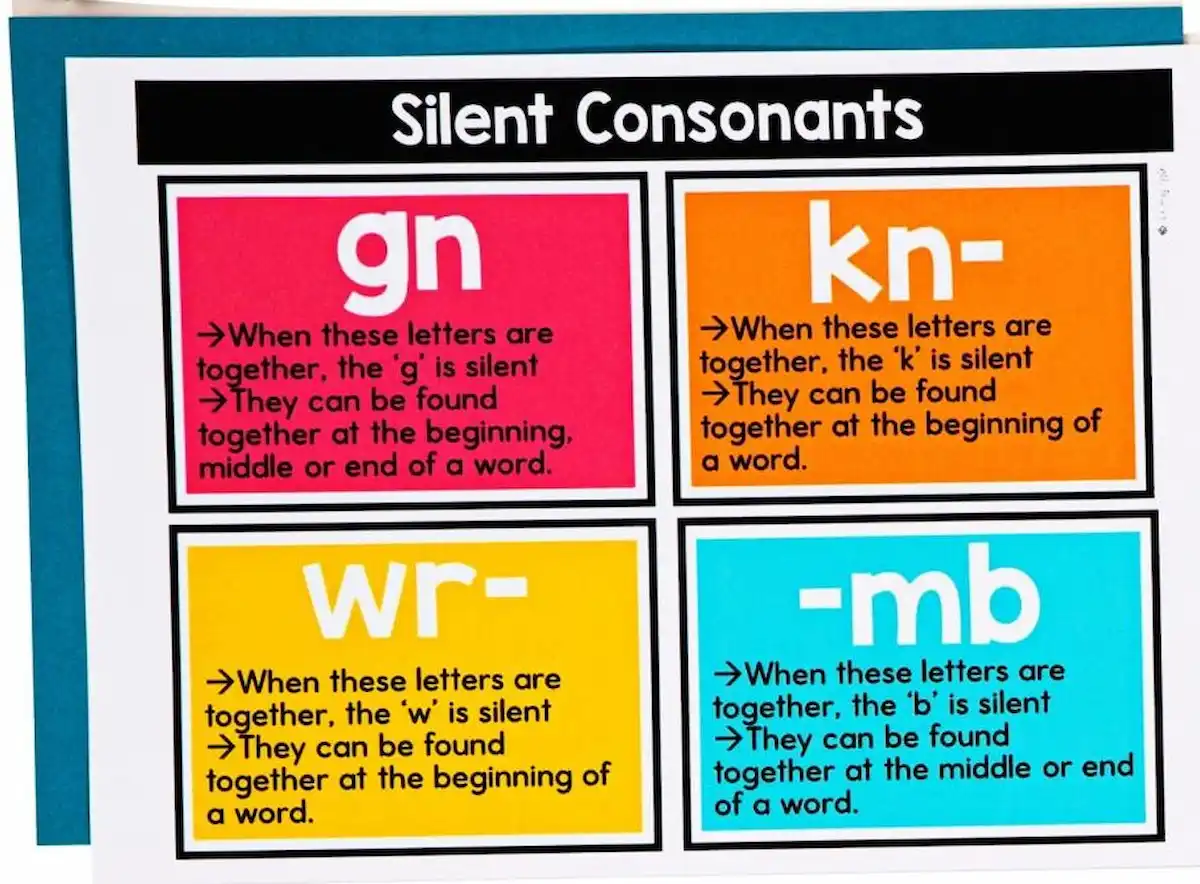
To build a child’s reading foundation, you need to introduce them to the fundamental concepts gradually over time. Letter-sound correspondence, blending, vowel teams, and other essential components all need to be taught. These are some of the most common elements of reading development exercises used in schools during the early years of education. Apart from them, kids also need to grasp the knowledge of silent letters, which form an equally important part of the English language. Teaching children silent letters can be challenging, especially without access to proper resources. If you want your child to read fluently, teach them about silent letters. Let them learn about common combinations like ‘mb,’ ‘gn,’ ‘wr,’ and others.
You can use a proper decodable text for this teaching goal. Look for a book that engages your child’s senses in a fun-filled manner. A good book will feature words with silent letters, such as ‘wr,’ ‘kn,’ and ‘ph.’ You can also find lessons on soft ‘c’ and ‘g’ sounds. They can impart these critical lessons through stories with beautiful pictures. The book’s structured format, based on the Orton-Gillingham methodology, is another reason to use it when introducing your child to silent letters. You can trust it to make a lasting impact on their reading development. But why is it important for your child to learn these letters?
Let’s quickly explore this area.
Origin of a word
Whether you’re learning English or another language, a deep understanding is essential. In this context, it’s important to understand that silent letters provide a glimpse into the origin or meaning of a word. For instance, take the word ‘doubt.’ It comes from the Latin word ‘dubitare’ and is also linked to ‘dubious.’ In the 15th century, English spellings were yet to be determined. Writers and others wanted to prove that most words are either Greek or Latin. Hence, they introduced silent letters so that everyone remembered the etymology of a word.
Close relationship with other words
Silent letters also share roots with some other words. For example, the ‘g’ is silent in ‘sign.’ If you consider words like ‘signature’ or ‘signal,’ these are pronounced differently. In the same way, letter ‘b’ is silent in ‘crumb.’ However, in ‘crumble,’ the ‘b’ is pronounced. How does your child learn these differences? Use decodable books to teach them that ‘b’ remains silent in words that end with the ‘mb’ combination.
Additional information
Whether you’re teaching silent letters or something else, it’s crucial to have your child practice what they’ve learned. Through decodable readers, you can introduce your child to different types of words with the silent or ghost letters. Initially, they may not differentiate between ‘kn’ and ‘n’ or ‘r’ and ‘wr.’ You have to make them practice spellings with specific letter and sound combinations for reading success.
Some online platforms allow you to download decodable books. You can use these books anywhere, even during vacations, to ensure your child continues to learn. At the same time, know what your child has already learned and how you can add new lessons to their reading routine.