
Verifying income is often the most critical hurdle loan officers face when guiding a buyer toward clear-to-close. A minor oversight in calculating qualifying monthly earnings can derail an underwriter’s approval or trigger an unexpected condition late in the process. Originators quickly learn that no two financial profiles look identical. While W-2 employees present structured pay stubs and predictable base salaries, self-employed borrowers present complex tax returns full of write-offs, business deductions, and fluctuating revenue streams.
Navigating this gap requires originators to balance strict agency underwriting criteria with practical efficiency. Establishing a repeatable, systematic verification workflow helps loan officers evaluate qualifying stability faster, reduce underwriting kickbacks, and deliver seamless pre-approval experiences for every applicant.

Income Requirements by Loan Types
Different mortgage programs evaluate qualifying income through distinct risk lenses. Originators must align a borrower’s financial profile with the specific guidelines governing each program before issuing a pre-approval.
- Conventional Loans (Fannie Mae & Freddie Mac): Require two years of stable income history. Qualification relies on gross base earnings for salaried staff and net taxable income for self-employed individuals.
- FHA & VA Loans: Focus heavily on income continuity over two years. VA loans additionally enforce strict residual income requirements based on family size and geographic region.
- Jumbo Mortgages: Demand higher income thresholds, rigorous reserve documentation, and flawless two-year earnings stability.
- Non-QM Programs: Offer flexible alternatives for non-traditional borrowers. Options include 12-to-24-month bank statement programs, 1099-only verification, Profit & Loss (P&L) statements, Written Verification of Employment (WVOE), and Asset Utilization. Debt-Service Coverage Ratio (DSCR) loans ignore personal income altogether to focus on rental cash flow.
Full Tutorial to Verify Income for a Mortgage
Verifying income requires more than running numbers through a spreadsheet. It demands a structured step-by-step process that moves from initial document intake to final investor verification. Skipping a single verification step can lead to unconditioned loan resubmissions or missed debt-to-income (DTI) thresholds.
By standardizing the income verification workflow, originators ensure every tax form, pay stub, and bank statement aligns with investor rules long before the loan file hits an underwriter’s desk. Here is the full step-by-step process loan officers follow to verify income accurately and efficiently.
Step 1: Document Collection & Initial Review
The verification process begins with gathering baseline income records based on the borrower’s employment structure. For traditional wage earners, loan officers collect recent pay stubs covering 30 consecutive days alongside the most recent two years of W-2 forms. For self-employed applicants, originators collect two years of personal (1040) and business tax returns (1120S, 1065, or Schedule C) with all supporting K-1s.
Initial review focuses on consistency: originators check if Year-to-Date (YTD) earnings on pay stubs match historical base pay, identify gaps in employment exceeding 30 days, and confirm whether tax returns contain all required signatures before proceeding to deep calculations.
Step 2: Income Calculation & Analysis
Once documents are collected, loan officers convert raw earnings into qualifying monthly income. For salaried staff, calculating base wages is straightforward, but variable pay like overtime, bonuses, or commissions requires a 24-month average. When working with self-employed borrowers, originators analyze net business income and add back non-cash expenses like depreciation and amortization. Originators frequently consult detailed guides on how to calculate gross income, net income, standard employment income, and self-employed income to prevent math errors.
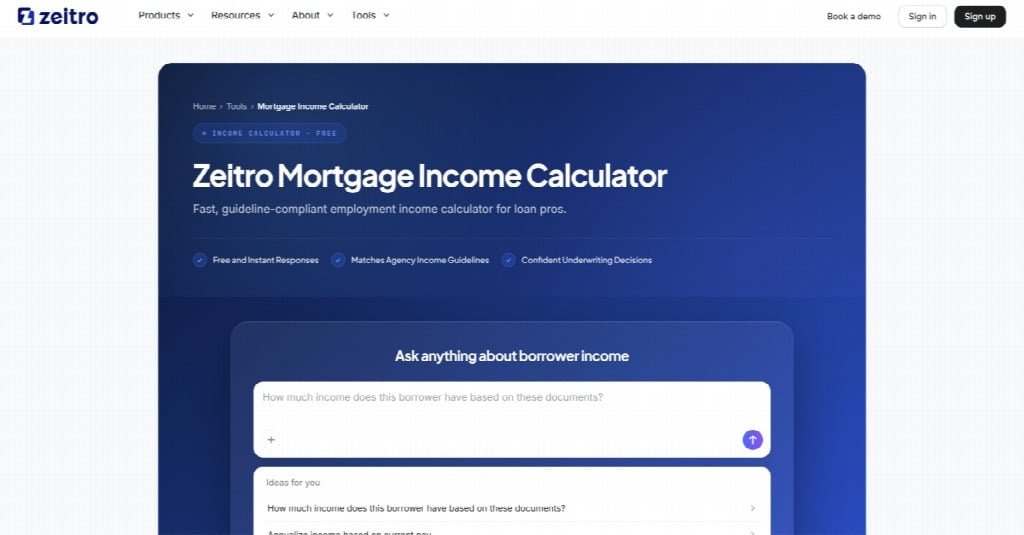
Modern originators also upload tax returns and pay stubs directly to an online mortgage income calculator, which automatically parses complex tax schedules and calculates qualifying monthly income for both W-2 and self-employed profiles in seconds.
Step 3: Investor Guideline Matching & Verification
Calculating the income is only half the battle; originators must confirm that the calculated income meets the specific underwriting guidelines of the targeted investor. While Fannie Mae might require two years of self-employment history, a non-QM investor might accept a 12-month bank statement program with a CPA-certified expense ratio.
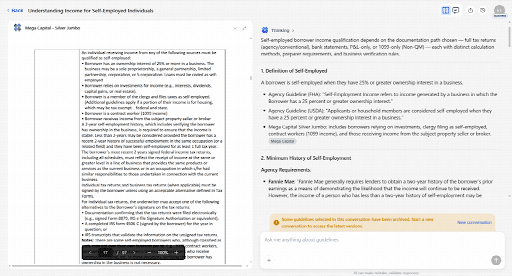
Instead of spending 30 minutes reading through hundreds of PDF guideline manuals, loan officers use Zeitro Strata to search guidelines instantly. Powered by DeepSearch across 100+ investors (including AD Mortgage, AmWest, CMG Financial, and Luxury), the AI assistant provides 100% citation-backed answers with exact source links. Originators can even use the “Explain” feature to clarify nuanced investor policies instantly.
Step 4: Area Median Income & Program Eligibility Validation
The final step involves validating whether the borrower’s calculated income impacts special loan program eligibility. Programs like Fannie Mae HomeReady, Freddie Mac Home Possible, and various Down Payment Assistance (DPA) grants set strict upper limits based on Area Median Income (AMI).
If a borrower’s earnings exceed 80% or 100% of the local AMI, they may lose eligibility for reduced mortgage insurance rates or closing cost grants. Loan officers can interactively query Zeitro Strata in plain English to check local AMI thresholds, match state-specific DPA programs, and pull live mortgage rate sheets to lock in accurate pricing.
Income Documents Needed
Having a complete document package prevents unnecessary underwriting conditions. Loan officers typically categorize document requests based on whether the applicant earns traditional W-2 wages or receives self-employed income.
- W-2 Salaried & Hourly Employees:
- Pay stubs covering at least 30 consecutive days (showing YTD earnings)
- W-2 statements from the past two years
- Signed Form 4506-C for IRS tax transcript validation
- Written or Verbal Verification of Employment (WVOE/VVOE) from current employer
- Pay stubs covering at least 30 consecutive days (showing YTD earnings)
- Self-Employed & Non-QM Borrowers:
- Federal tax returns (Form 1040), including Schedule C, E, or F for the last 1–2 years
- Business tax returns (Form 1120, 1120S, or 1065) with Schedule K-1s
- 12 to 24 consecutive months of personal or business bank statements (for Bank Statement loans)
- Year-to-Date Profit & Loss (P&L) statement and Balance Sheet
- 1099 forms and a CPA letter verifying business ownership and active operation
- Federal tax returns (Form 1040), including Schedule C, E, or F for the last 1–2 years
Tips for Loan Officers to Verify Mortgage Income
Experienced loan officers follow specific operational habits to minimize underwriting kickbacks and speed up loan processing times.
- Isolate One-Time Earnings: Exclude temporary capital gains, one-time severance packages, or single-year bonuses unless there is documented evidence that the income will continue for at least three years.
- Maximize Valid Add-Backs: When analyzing Schedule C or Form 1065, originators should add back non-cash expenses like depreciation, amortization, and depletion to restore qualifying income for self-employed buyers.
- Watch for Declining Income: If a self-employed borrower’s latest tax year shows lower net income than the previous year, underwriters will almost always use the lower, current figure rather than a two-year average.
- Leverage Automated Guideline Search: Manual guideline lookups waste valuable time. Using citation-backed AI assistants ensures that originators quote exact investor overlays without risking underwriting rejections.
Conclusion
Accurate income verification forms the bedrock of every successful mortgage application. By distinguishing between traditional wage earners and self-employed borrowers, maintaining a thorough document checklist, and utilizing modern tools like Zeitro to parse guidelines and automate calculations, loan officers can dramatically shorten processing times, minimize underwriting errors, and guide more clients smoothly to closing.