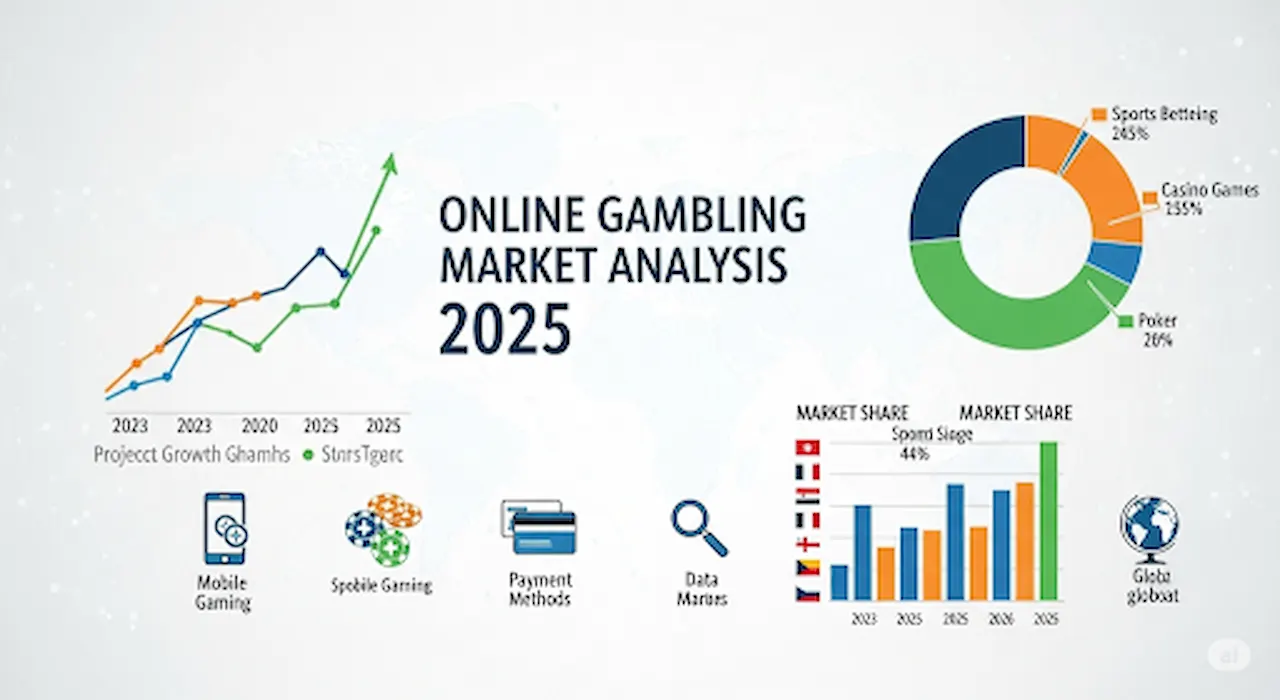
On the global front, the market size of online gambling can be estimated at a high of $117.5 billion in the year 2025. The main driving forces behind this upward trend are the ubiquitous use of the smartphone, the constant legalization of regional gambling practices, as well as the constant digital innovation. Although Europe has a huge market dominance, the United States is experiencing phenomenal growth. One major trend is the mobile-first nature of the market, where 80 percent of users were accessing the platforms on their devices.
Moreover, the implementation of modern features that are grounded on technologies, like AI, Virtual Reality, Augmented reality, and blockchain, alters the user experience and assists in generating a new type of engagement. Players within the sector continue to focus on effective cybersecurity measures and navigation in thick regulatory settings.
Global Market Size and Growth Projections (2025-2029)
The online gambling industry keeps up its grandiose growth until 2025. Global market size is expected to hit $117.5 billion by the end of 2025, representing a 10.6 percent increase as compared to the previous year’s aggregate of 106.22 billion. This rate of growth means that there is a continuous increase in the rate of taking up digital gambling globally.
Beyond that, the market is expected to sustain a very strong compound annual growth rate (CAGR) of 12.3 percent between 2025 and 2029 to attain an estimated $186.58 billion in the latter year. The projection highlights the certainty of long-term growth of the online gambling industry due to the continuous technological growth and rise of consumer interest in it.
The above double-digit compound growth rates between the years 2024 to 2025 and beyond reflect the strength of the industry and its capacity to harness the changing consumption preferences post-pandemic towards online consumption. This momentum is one of the indicators of value to the stakeholders, analyzing their opportunities to invest and even penetrate the market.
Market Segmentation by Game Type
The sports betting and online casino monopoly characterize the online gambling of the year 2025 as a dominant market that has attracted most of the revenues in the industry. The market share occupied by sports betting is estimated to be a substantial 42.3 percent, and this is expected to be boosted by the legalization that has entered new jurisdictions, especially in the U.S and Europe. The highly popular global sporting events and the emerging in-play betting practice that is promoted by AI-assisted odds and real-time data support this segment.
Among the more interesting sub-segments is Esports betting, which has been experiencing fast growth, notably among Gen Z users, and that is projected to generate nearly $2.8 billion in revenue this year. And then come the online casinos, which are likely to have a market share of 30.5 percent. They are benefitting significantly due to mobile-first experiences and the immersiveness of live dealer games, which can be captured via high-definition streaming, recreating a real casino in real time. The other market is divided between different, smaller yet innovative groups.
The Others segment, which comprises Virtual and Fantasy Sports, commands 9.6 percent of the market, riding on innovation in AR and VR. The segment of The Lottery takes 9.1 percent as it can be played using mobile devices, and Poker and Bingo take 5.4 and 5.6 percent respectively, the former being of interest to players focused on strategic aspects and the latter developing on social platforms in online variants.
Market Segmentation by Device
Mobile is massively ruling the online gambling scene of 2025, with around 80 percent of users logging into the platforms through mobile phones. The trend is a logical consequence of smartphone penetration worldwide and convenience/accessibility being used by consumers. The low latency and high speeds of the 5G connection, combined with mobile-first platforms and apps, are the industry standard. This is the synergy of technology that provides quality gameplay and an overall fantastic user experience. Complex transactions have also been simplified by the adoption of smart digital solutions in payments such as cryptocurrencies. Despite being a niche product, the desktop market is decreasing. The evident tendency shows that the further development of online gambling will be conditioned by certain adaptability and immersiveness in betting suggested by mobile devices.
Regional Market Analysis (2025)
The contemporary online gambling industry has a wide range of regional characteristics, with mature centers continuing to lead in the industry, and their younger counterparts showing quite promising results.
Europe
The European region has a huge 49.1 percent market share of the worldwide internet gambling industry in 2025 due to well-established regulations and consumer trust. One of the reasons behind this dominance is the strength of European online casinos, of which the casino games are the biggest in online gross gaming revenue. To illustrate, the United Kingdom, which has high online penetration, has reportedly attracted a lot of revenue through such platforms.
The total Italian gambling industry is the largest in Europe, with the online share amounting to five billion dollars, and France delivers four billion dollars. Also, Nordic nations such as Sweden, Finland, and Denmark present robust participation in online gambling, where online activities contribute nearly 68 percent of overall revenues in gambling.
North America
The online gambling industry is booming in North America, with the US market itself expected to top almost $40 billion by 2029. It is expected that the total online gambling industry in North America will see a CAGR of 12.2% between 2025 and 2030 and reach the level of $32.95 billion by 2030. This increase is especially explained by the modification of attitudes toward gambling and by the massive legalization works in the United States and Canada. By 2025, 7 American states will have completely licensed online casinos and Online poker rooms, whereas 30 states allow online sports betting. Liberation of the availability of varied forms of online gambling wherever they may be is broadening the audience.
In February 2025, the United States recorded a total gross gaming revenue (GGR) of over 5.86 billion, representing a growth of 4.2 percent as compared to February 2024. The total production of online games that includes online sports book and iGaming grew by 27.5% in May 2025 to attain $2.19 billion. In May 2025, iGaming revenue increased by 33% and online-themed sports betting revenue increased by 21.4%. The increasing popularity of in-play betting, which comprises almost 70 percent of total sports wagers, is a big growth factor.
Asia-Pacific
The Asia-Pacific region offers a high-potential market opportunity, and according to its casino gambling market in 2025 is expected to be approximately $98.98 billion, and is expected to grow to reach $140.39 billion by 2030, which will yield a 7.24 percent CAGR. The driver of this growth can be attributed to additional smartphone and internet penetration, and the changing regulatory environment, making the market safer to gamble. And some of the major global centers, such as Japan, India, and the Philippines, are defining the future of iGaming in APAC, where a particular shift is witnessed to digital interaction.
Local games like Sic Bo in China and Pachinko in Japan have been gaining popularity, and this is a sign that relevancy in culture is key when it comes to offering games. An example is the scenario in Thailand where new laws are being seriously discussed to help in controlling its online gambling business, which has been practically under the role of underground betting with an approximate amount of a yearly turnover of 148 billion dollars.
Latin America
Latin America is also fast becoming an emerging growth market in online gambling in the world, with its population of nearly 670 million and an increasing digital adoption curve. Online gambling in the region is anticipated to overtake $10 billion in annual revenue by the year 2026, which is a significant jump compared to $2.6 billion in 2020. Brazil is the most attractive market in terms of potential and size, being considered amongst the largest regulated iGaming markets in the world.
It is already projected to produce about $6.7 billion in annual turnover by 2028 in online gambling alone, with more than 100 million participants in real money games. The new regulatory paradigm of the Brazilian government, which came officially into force on the first of January 2025, is aimed at consumer protection, the transparency of the fiscal policy, and strict control by the Ministry of Finance. There are also other vibrant countries, such as Mexico, Colombia, and Peru, that also have strong growth, and the varied regulations also play a big role in the dynamic nature of the region.
Middle East & Africa
Demand in the Middle East & Africa (MEA) area is gradually growing in the online gambling industry with the rising accessibility of the internet as well as the proliferation of smartphones. Online gambling is estimated to be worth 8.42 billion dollars in this area by 2025. In a wider sense, the total gambling market of the African continent is estimated to reach a 17.63 billion figure in the year 2025 and increase by a CAGR of 4.23% between 2025 and 2029. The three largest gambling markets in Africa are identified as South Africa, Nigeria, and Kenya.
The most promising vertical in most African markets is sports betting, especially mobile football betting, to capture the popular passion for sports. There is also proactive regulatory like new Nigerian tax regulations (5% on winnings of residents and 15% of non-residents), elevated excise tax in Kenya (increased to 15% as opposed to 12.5%) as well as new withholding tax in Morocco (30% of foreign online winnings) and Zimbabwe (10% of gross winnings on sports betting). These are some of the efforts that governments have taken to ensure that the industry is controlled, and taxation is also enjoyed in the expanding online gambling industry.
Key Market Drivers
A combination of economic factors that includes the continued growth of the online gambling industry in the year 2025. The most prevalent access point is through smartphones and mobile platforms, with about 80 percent of people choosing the convenience of gaming on the move, hence indicating a massive change in the behavior of gamers. It is supplemented by the latest technology, in which AI, VR, and AR make it immersive and individualized.
Meanwhile, blockchain and cryptocurrencies are making procedures more transparent and trusted. The continued legalisation of online sports betting and online casinos in markets such as the U.S, and the fact that niche divisions of the industry, such as Esports betting and interactive live dealer gaming, are becoming increasingly popular, means the industry is getting wider audiences and tapping vast new income sources.
Emerging Trends and Opportunities
The gambling industry in 2025 is characterized by the amalgamation of superior technology and adroit game strategies. One of the leading trends of this evolution is Artificial Intelligence (AI) that moves past mere personalization into being able to perform real-time fraud checks and post odds change in the case of online sports betting. Responsible gambling tools are also improved by AI, and customer support is streamlined, whereas the presence of AI-powered live dealers offers novel, more engaging, and responsive contact with the players.
To accompany this, the use of Virtual Reality (VR) and Augmented Reality (AR) is transforming games to be a highly interactive environment that gives players a chance to navigate casinos virtually, and they can be used to project games in the living room. The aspect of the evolving affordability of VR headsets is a major part of the rationale behind the forecasted annual growth of this segment by around 30%.
In the meantime, blockchain technology and cryptocurrencies promote a platform of credibility and effectiveness. They allow provably fair games where games can be proved, and there are quicker, lower-cost transactions. Decentralized casinos and tokenized rewards are two options that provide new paradigms of player involvement and regulation. On the tactical side, gamification and powerful loyalty plans, like the MGM Rewards and Caesars Rewards, are being used to retain players and enhance the lifetime value of the customer.
Moreover, intelligent collaborations and centralization of localized content, such as regionally-specific games and methods of payment, are essential to the process of entering different markets and establishing the brand, as well as to future development and improvement within the realm of online gambling, which is as lively and competitive as ever.
Challenges and Restraints
The online gambling market is exploding in 2025, and there are substantial and multidimensional challenges to the new normal, which require operators and regulators to react to them carefully and coordinately. Underlying such problems are the complex and dynamic regulatory environments, which have led to a fragmented, costly environment. U.S. legislation is a patchwork of regulations varying between states, and platforms are required to ramp up legal oversight efforts, which can absorb up to and above 30 percent of company earnings.
This is similar to the case in Europe, where different laws regarding licensing, tax, and, more importantly, advertising impose high costs of compliance on the operators. The danger of such rigid regulations pushing the casinos to unregulated black-market practices unknowingly, has already been a critical issue in other countries such as Sweden and Poland.
Adding to the regulatory haste are intense societal questions, especially that of the increasing popularity of problem gambling. A combination of the availability of 24-hour online casinos and sports betting sites has led to increased outbreaks of disordered gambling, with an alarming proportion of 16 percent of online sports bettors exhibiting symptoms of addiction. Another disturbing pattern in 2025 is the increased overconfidence of bettors, as 86 out of them think they can easily earn money, which is an attitude that can lead to even more devastating financial consequences. This poses a great risk to vulnerable populations, such as emerging adults, who may circumvent age limits.
The tough competition and market saturation, as new competitors such as Fanatics and ESPN Bet do battle with industry leaders, is also a problem that the industry has to deal with. This means a tactical change towards cost-effective customer retention rather than costly customer acquisition.
Lastly, it presents an industry prone to permeating cybersecurity risks and fraud, as well as bonus manipulation and fabricated accounts. This forces the need to invest perpetually into complex tools, usually based on AI, to secure sensitive player data and financial transactions. The need to be compliant with AML and KYC requirements, and the necessity to ensure rising data privacy rates, is the key to lasting consumer confidence and market sustainability.
Competitive Landscape
The online casino industry in 2025 is an incredibly competitive environment, characterised by a combination of both established international giants and new ambitious entrants. The consumers consist of giants such as Flutter Entertainment, bet365, and Entain, which compete with North American giants FanDuel and DraftKings, who remain the seekers due to high financial returns. An example of such optimism is FanDuel is drawing around $7billion in income with 29 percent growth, whereas DraftKings anticipates its actual initial mark of profitability with more than 6 million month-to-month active players.
BetMGM and Caesars Digital are other important U.S. incumbents that are also stepping up their iGaming presence and exploiting effective affinity schemes such as the Caesars Rewards. The entry of other companies like Fanatics Betting and Gaming and ESPN Bet is also promoting aggressive competition in the market by thriving in the new market entry. Companies are implementing holistic strategies in a bid to stay ahead of the game. The main emphasis is on technological innovation, such as the inclusion of AI to have personal experiences and cryptocurrency to handle secure transactions.
They are making extensive investments in mobile-first products and in-game experiences based on live dealers in order to improve user experience and retention. Customer loyalty is one of the key priorities, and the gamification and reward systems are created to increase long-term engagement. Furthermore, strategic alliances, sponsoring and merging, and acquisitions are vital to increase market and brand impression. The growing regulatory pressure on the industry means that compliance, ethical marketing, and strong cybersecurity solutions, such as KYC and AML policing, are crucial to the ongoing development of the industry and gaining a competitive edge.
Also read: Betting Beyond Borders: Exploring the World of Gambling and Its Diverse Cultural Impact