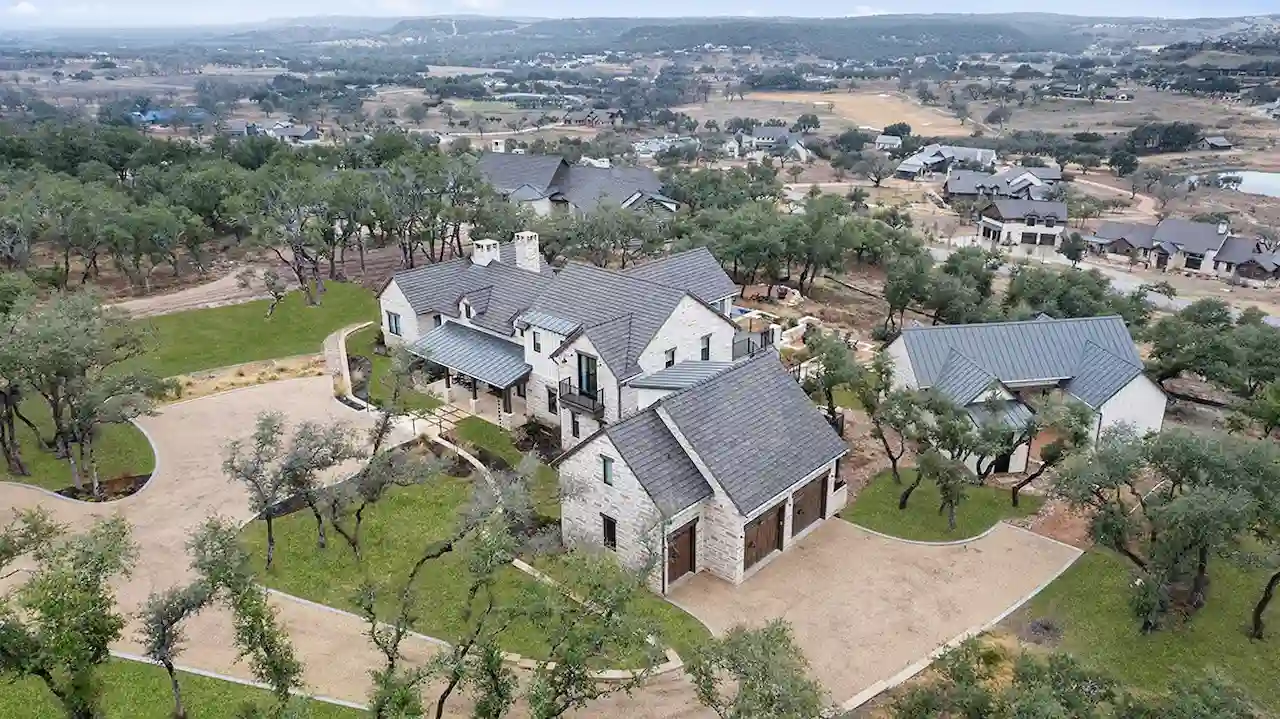
The purchase price is the number everyone negotiates and the least interesting number in the file. What decides whether you enjoy a place on acreage west of Austin is the recurring column, and on a Hill Country property that column is longer, stranger and considerably less predictable than it is on a house in a subdivision.
You find most of it out in the first year. Usually in spring, when the tax notice, the first real irrigation demand and the first storm that moves your driveway all turn up inside about six weeks of each other.
None of this is an argument against acreage. It is an argument for pricing acreage properly before you own it, which is a thing you can do from a desk if you know what the categories are.
Property tax, and the valuation you may be inheriting
The county appraisal district determines a value. The taxing entities whose boundaries cover the parcel adopt rates. Your obligation is the sum of them, and on rural and semi-rural land the entity list can include a county, an emergency services district, an independent school district, a community college district, and in some developments a municipal utility district or public improvement district that financed water, wastewater or roads.
Two mechanics matter more here than they do in town. Value is protested annually through the district, and on unusual property the protest is won on evidence about that property rather than on anything resembling a comparable. And much Hill Country acreage carries an open-space valuation for agricultural use or wildlife management, which values the land on its use instead of its market value. That valuation is attached to the use, not to the dirt. Change the use, or fail to maintain the qualifying activity and the plan behind it, and the assessment mechanics reach back over prior years. Anyone buying a luxury home in the Hill Country on land under that valuation should understand what the qualifying use actually requires of them before closing, not after.
The seller’s exemptions are the seller’s. A homestead exemption, and the limitation on appraised value that comes with it, belongs to the person who claimed it. You claim your own, through the district, on your own timeline.
Worth knowing too: Texas is a non-disclosure state, so sale prices are not in the public record. That cuts both ways on a protest. Neither you nor the district can simply look up what the neighbours traded for, which puts more weight on documented condition, access limitations and the physical particulars of the tract.
Water, when you are the utility
Where there is no municipal supply, you are the water utility, and the job comes with equipment, paperwork and a weather dependency. The sequence people go through looks roughly like this:
- Establish what the supply actually is. A well on the parcel, a shared well under an agreement, a water supply corporation connection, or hauled water into storage.
- Get the well and its equipment assessed. Depth, casing condition, pump age, recovery rate and the pressure tank are all consumable and all have service lives.
- Test the water. Hardness and mineral content in this region routinely justify softening and filtration, and treatment equipment means media, salt and servicing.
- Find out which groundwater conservation district covers the land and what it requires in the way of registration, permitting or reporting.
- Plan for a dry year. Drought changes recovery rates, restricts what landscaping survives, and occasionally turns storage capacity into the binding constraint on how the place runs.
Rainwater collection is common out here and worth asking about, because a functioning system is an asset and an abandoned one is a repair.
Wastewater has its own paperwork
An on-site sewage facility is permitted, and the permit is a real document with real conditions. Conventional septic and aerobic systems are different animals. Aerobic treatment units generally require an ongoing maintenance arrangement with a licensed provider, periodic inspections, chlorine or another disinfectant, and a spray field or drip field that has to be kept clear and functioning.
Two things to establish early. What the system was permitted to serve, expressed in bedrooms, because that caps your expansion plans until you go back through the county. And where the drainfield sits, since anything built, paved or parked on top of it shortens its life considerably.
Insurance prices the land as much as the house
Carriers underwrite an acreage property differently, and the factors are mostly about setting rather than square footage. Distance to a responding fire department and to a usable water source. Vegetation density and whether a defensible space has been maintained around structures. Roof age and material, in a region where hail is a routine event rather than a rare one.
Then there are the things a subdivision house does not have. Barns, shops, guest quarters and pump houses are typically scheduled separately rather than covered by implication. Ponds, livestock, gates, trails and anything a guest can ride create liability exposure that belongs in the conversation. Flood is a separate policy and the answer depends on where the parcel sits relative to mapped hazard and to a creek that has its own opinions. Custom construction raises the replacement-cost question, because rebuilding something bespoke is a different exercise from rebuilding something standard.
The driveway is a capital item
City buyers hear private drive and picture a feature. What arrives is an asset with a maintenance schedule attached.
A long caliche or chip-seal drive needs periodic resurfacing and it sheds material every time water runs across it. Culverts silt up. Low-water crossings do exactly what the name says, on a timetable nobody controls. Gates have motors, motors have boards, and boards fail in heat (always in August, never in March). Cattle guards need clearing. Erosion after a hard rain can move enough material to require equipment rather than a shovel.
Where the drive is shared, there is usually a road maintenance agreement, and the quality of that agreement determines whether repairs happen by consensus or by argument. Read it before you sign anything. It tends to be the shortest document in the file and the one most likely to matter.
Land does not hold still
Acreage reverts. Left alone, ashe juniper regenerates, brush thickens, fence lines disappear and pasture stops being pasture. The recurring work is unglamorous and constant:
- Shredding or mowing the open ground, at a frequency set by rainfall rather than preference.
- Clearing regrowth and keeping fence lines walkable.
- Managing invasive species before they become the dominant cover.
- Tree work near structures, drives and power lines, with oak wilt precautions dictating when pruning can safely happen.
- Erosion control on slopes, swales and anywhere water concentrates.
- Protecting new plantings from wildlife, which out here means real fencing rather than a token barrier.
You either do this yourself, with equipment you now own and maintain, or you contract it. Both are lines in the column.
Systems multiply with the footprint
A large house on acreage carries more of everything. Several HVAC zones instead of one or two, each with its own service life. Propane rather than natural gas in much of the region, which brings a tank, a delivery relationship and a consumption pattern you learn over a winter. A standby generator, if the property has one, needs exercising and servicing to be worth having.
Pools and water features on a well are a specific case, because the make-up water comes out of your own supply. Irrigation on a well is the same problem at larger scale. Add long plumbing runs, exterior and landscape lighting, gate and security equipment, and a pest and rodent situation that is simply what happens when a building sits in the middle of habitat.
Shared obligations you agreed to at closing
The last category is the one buyers skim. A ranchette subdivision may have a property owners association, a road association, or both, with assessments and architectural control. Some developments sit inside a utility or improvement district with its own levy. A shared well comes with an agreement allocating cost, capacity and repair responsibility. Deed restrictions can limit structures, livestock, short-term rental or subdivision of the tract. And where part of the land sits under a conservation easement, the holder has monitoring rights and the permitted uses are fixed by a document you did not write.
Mineral and water rights are worth a direct question as well, since they can be severed from the surface and that affects what someone else may be entitled to do on your ground.
The honest way to arrive at a number is unglamorous. Walk the property with whoever has been maintaining it and ask what they spent last year on each of these categories. Ask for the invoices. Ask for the well and septic records, the maintenance contract, the road agreement and the last insurance declarations. Sellers of well-kept places usually have a file, and the ones who do not have just told you something useful. Compared against what a luxury home in Austin actually costs to hold inside city limits, the Hill Country column is not necessarily larger. It is differently shaped, and the shape is the part you can only learn from the person who has been paying it.
Also read: Estero Florida Real Estate – SW Florida’s Best Kept Secret